The Old Golf Course Ponds Off Placida Road Are a Tarpon Nursery, and the Net Pulls Start Again This Month
November 12, 2026
November 12, 2026
On May 12, 2025, a juvenile tarpon carrying an acoustic transmitter swam out of Pond 2 at Lemon Creek Wildflower Preserve. It went through the mangroves and under State Road 775, and receivers near the spot where Lemon Creek meets Lemon Bay picked it up. A weather system with strong southwesterly winds had pushed a king tide in that day. According to the Florida Fish and Wildlife Conservation Commission's November 2025 report, the fish left right at the peak of that tide.
It was the bigger of the first two tagged fish to leave, and it left more than a month ahead of the smaller one, which waited until June 23.
That pattern explains what is happening behind the Gasparilla Pines Boulevard entrance. The young tarpon in these ponds leave on the water's schedule. The tide sets the date they go, and the date sets how big they are when they reach the bay. Starting Saturday, November 21, anyone on the Cape Haze Peninsula can help count them.
The preserve covers 80 acres at the southeast corner of Placida Road and Gasparilla Pines Boulevard. It ran as an 18-hole executive golf course from the early 1970s until 2006, then sat abandoned and overgrown.
Lemon Bay Conservancy agreed to buy it for $750,000 in the summer of 2010. Community and estate gifts covered $500,000, and a local philanthropist loaned the other $250,000. The sale closed in September 2010, and the loan was paid back by September 2011.
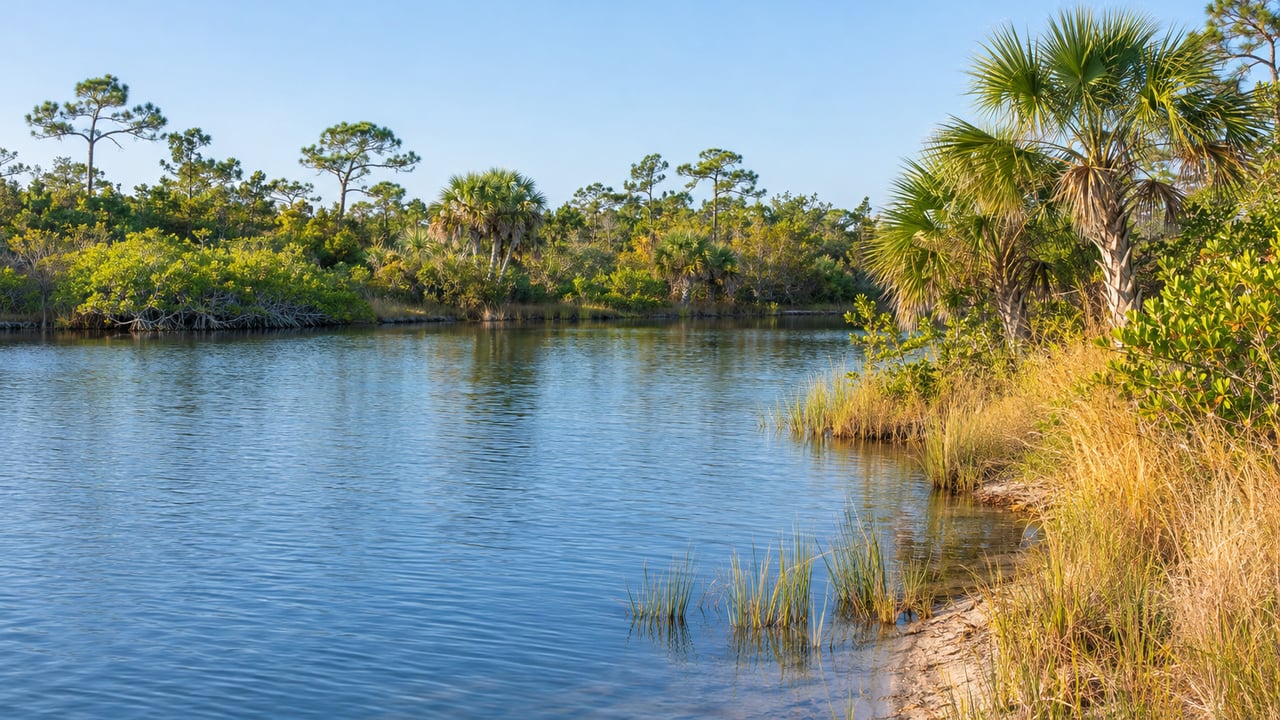
The golf course left behind water hazards, and the restoration built on them. The Conservancy worked with the Southwest Florida Water Management District and NOAA on a $2.1 million project that joined the old course ponds into connected wetlands and restored the uplands around them. Most of the trees went in during 2020, and the Conservancy lists the project as finished in January 2021. The site now runs from uplands through freshwater ponds, marshes and tidal wetlands to Lemon Creek, which drains into Lemon Bay. Four loop trails cross it, and bird surveys have recorded more than 115 species.
Tarpon research here began in September 2012, years before the restoration, with Bonefish & Tarpon Trust as a partner from the start. Young tarpon rely on shallow marsh and mangrove nurseries to feed and grow before they move into open estuaries. In its 2016 journal, Bonefish & Tarpon Trust called the juvenile stage an essential link to the adult fishery. It reported that tarpon in the preserve's altered ponds showed little or no growth, so fish that left were smaller and more exposed to predators.
The Englewood Sun reported that researcher JoEllen Wilson measured and tracked hundreds of juvenile tarpon in these ponds, using PIT tags to follow them between the ponds and the estuary.
FWC described the old ponds the same way. Before the restoration, the fish seemed crowded and weren't growing to the sizes seen in natural habitat before they left. The connected wetlands were built to fix that by giving the fish more room and more food.
To find out whether the fix worked, FWC used a NOAA grant to put acoustic receivers throughout the restored ponds in March 2025 and implant transmitters in tarpon. By the November 2025 report, nine fish had been tagged. Receivers outside the preserve, west of SR 775, had picked up three of them.
| Tagged fish | Where it spent its time | Left the preserve | Water that day |
|---|---|---|---|
| Tarpon 1 | Stayed in Pond 2 | May 12 | King tide driven by strong southwesterly winds |
| Tarpon 2 | Stayed in Pond 2 | June 23 | High enough for a smaller fish, not a king tide |
| Tarpon 3 | Moved between the east and west sides of Pond 2, and also used Ponds 1 and 3 | June 23 | Same tide as Tarpon 2 |
The three fish that left measured 18 to 29 inches. Tarpon 3's wandering matters to the researchers. It shows the fish are using several ponds and a large share of the new habitat, and FWC says they are far less crowded than before the restoration. The monthly net pulls also show tarpon reaching larger sizes inside the preserve since the work was done. In FWC's words, leaving for the estuary "at larger sizes than before gives the tarpon a greater chance of survival over the long run."
Getting out takes water. Data loggers in the preserve record water levels from tides, storm surge, rain and drought. The biggest fish left on the highest water, and the two smaller ones left together on a lower tide that was still high enough for them. Other ponds need even more water. Pond 6, where some tagged fish live, may need a storm surge from a tropical storm or hurricane before its tarpon can leave. FWC plans to follow the six fish still in the preserve for two more years. Receiver arrays near Sarasota Bay to the north and in Charlotte Harbor to the south may pick them up after they leave.
The high water that lets fish out of Pond 6 also reaches the rest of the preserve. Hurricane Milton's surge in October 2024 pushed far inland from Lemon Bay and covered almost the entire preserve. Afterward, the ponds in the eastern and central sections, which are normally fresh water, all tested highly saline. The restoration had used salt-tolerant plants in the western sections, where occasional high salinity was expected. Some plants in the east and center were not salt tolerant, and the Conservancy said those were unlikely to recover.
The surge also floated 30 recycled-plastic trail benches, each over 300 pounds. Some moved a short way and others moved hundreds of feet. Josh Olive, a Conservancy member and the Sun's Waterline editor, flew a drone over the preserve with board member and preserve co-chair Lary Stuhlmiller and found four benches that couldn't be seen from the ground.
In a June 2026 Conservancy article, Dana Houkal compared the two storms that hit the preserve directly. Ian in September 2022 brought 24.08 inches of rain at the preserve and gusts of 150 mph on Cayo Costa. Milton brought 6.85 inches of rain and gusts to 100 mph, along with heavy salt spray and surge. Volunteers staked 654 windthrown trees after Ian and 89 after Milton. Most were planted in 2020. The Milton trees were so much bigger that they needed 6-foot steel posts in place of one-foot wooden stakes, and nearly all of the staked trees survived after both storms.
The net pulls are how the Conservancy measures the size gains FWC reported. From November through April, on the third Saturday of each month, volunteers pull a 600-foot seine net with the Conservancy's Jon boat through the two western ponds near Fiddlers Green. Every fish is counted, measured and released, and the numbers go into an FWC database. Along with juvenile tarpon, the net brings up mojarra, mullet, snook and tilapia. At the first pull of the 2023 season, the smaller pond held 20 tarpon, and the larger pond produced a snook, mullet and ladyfish.
The 2026–27 net pull schedule:
Here is how the morning goes. Park in the Lemon Creek Wildflower Preserve lot at 3120 Gasparilla Pines Blvd. and meet at the equipment shed to load the net and gear into the Jon boat. The Conservancy's UTV then tows the boat to the ponds by Fiddlers Green, and volunteers drive over and park there. The pull starts around 8:30 a.m. in the smaller pond and usually wraps up around 10. Bring waders if you have them, plus gloves, a hat, water and mosquito repellent. The event listing gives a 7:45 a.m. meeting time at the shed and says the pull is "open to everyone in the local community that is interested in participating." RSVP to Malcolm Collingwood at 917-915-1076 or [email protected], and confirm the start time when you do.
Lemon Creek Wildflower Preserve doesn't take drop-in visitors the way a county park does. Conservancy members can walk in any day through the pedestrian gate. Everyone else comes in through scheduled walks, open houses and events. Memberships run by calendar year, and anyone who joins in October through December gets one to three extra months of benefits.
The rest of November on the Conservancy calendar:
Coral Creek is a separate juvenile tarpon habitat project from the one at the Wildflower Preserve. Volunteer work crews also meet at the preserve from 7 to 9 a.m. on Tuesday and Thursday mornings. They plant natives, tend the butterfly habitat, mow trails and clear vines.
Tarpon are as much a part of island life as the Boca Grande Causeway, and a few miles up Placida Road a December 19 net pull can show you a younger stage of that fishery. If you'd like to talk about life on the Cape Haze Peninsula, from tarpon season to which preserves and launches are close to home, Olivia Jones would be glad to share what she knows. Request a Private Consultation.
Stay up to date on the latest real estate trends.
November 12, 2026
November 5, 2026
October 29, 2026
October 22, 2026
October 15, 2026
October 8, 2026
October 1, 2026
September 24, 2026
September 17, 2026
Whether you are looking for luxury Boca Grande homes for sale or want to list your South Florida estate, I always provide exceptional service and diligent attention to detail. If you are looking to partner with a local real estate agent who will always put your needs first, let's see how we can work together!