Boca Grande Historic District FEMA 50% Rule Explained
August 20, 2026
August 20, 2026
In July 2025, the Boca Grande Historic Preservation Board sat through a case that should have been routine. A cottage owner wanted what half a dozen neighbors had already gotten that spring: permission to raise the house a few feet, keep its footprint, and move on. Instead the board heard that the project was more complicated than anyone expected. The cottage might need to be rebuilt rather than raised.
That single sentence is the whole story. Boca Grande's historic district carries a real exemption from one of the most expensive rules in Florida flood construction. But the exemption is not a feature of the address. It is a negotiated outcome, decided case by case, and it can fail even on a property everyone assumed would qualify.
If you own, are buying, or are renovating a home inside the district, that distinction is worth more than the square footage.
Every home in a FEMA flood zone lives under what's known as the substantial improvement rule, or the 50 percent rule. Lee County's own floodplain office puts it plainly: any structure where the cost of proposed improvements or repairs equals or exceeds 50 percent of the building's value must be brought into full compliance with current flood regulations, meaning the lowest floor gets elevated to the base flood elevation.
For a wood-frame cottage built before modern flood codes existed, that threshold is easy to cross. A kitchen gut, new bathrooms, and updated wiring on an older home can add up fast, and once the total crosses half the structure's assessed value, the whole building is expected to come up to current code, whether the owner planned an elevation project or not.
That is the rule the historic exemption is designed to soften.
Florida law does carve out relief for historic structures. Improvements to a designated historic building can be excluded from the 50 percent calculation, but only if the owner receives written approval from the Florida Division of Historic Resources confirming the work will not cost the structure its historic designation. Lee County's flood improvement guidance repeats the same condition: historic structures may be exempt from full compliance if that compliance would threaten their continued eligibility for historic designation.
Locally, the mechanism runs through the Boca Grande Historic Preservation Board itself. Lee County's guidance on the subject is direct: historically contributing structures can be exempt from the 50 percent rule, but the county evaluates it case by case, building by building. There is no blanket ruling that covers every address inside the district's boundary. Each renovation gets its own review.
Here is the part most buyers skip past. Sitting inside the boundaries of the Boca Grande Historic District does not automatically make a house a contributing historic structure, and only contributing structures get access to the exemption.
Lee County's own board files show how strict that test can be. In one case, a home built in 1999 on a lot that had held a demolished 1920 structure was found to be non-contributing, because the reconstruction failed to meet the Secretary of the Interior's standards for historic reconstruction and no strong justification of architectural significance existed in the original approval record. The general rule the board applies is that buildings less than fifty years old are not treated as contributing unless there is a documented historical or architectural reason to say otherwise. That house, despite standing inside the district, was required to follow the standard Design Guidelines Manual as a non-contributing property, and it remained just as exposed to full FEMA compliance as a home built anywhere else on the island.
In practice, this means a listing description that says "in the historic district" tells you almost nothing about renovation costs. What tells you something is the contributing determination on file with the county, and whether it has ever been challenged.
The clearest way to see how the exemption plays out is to look at what has crossed the board's table.
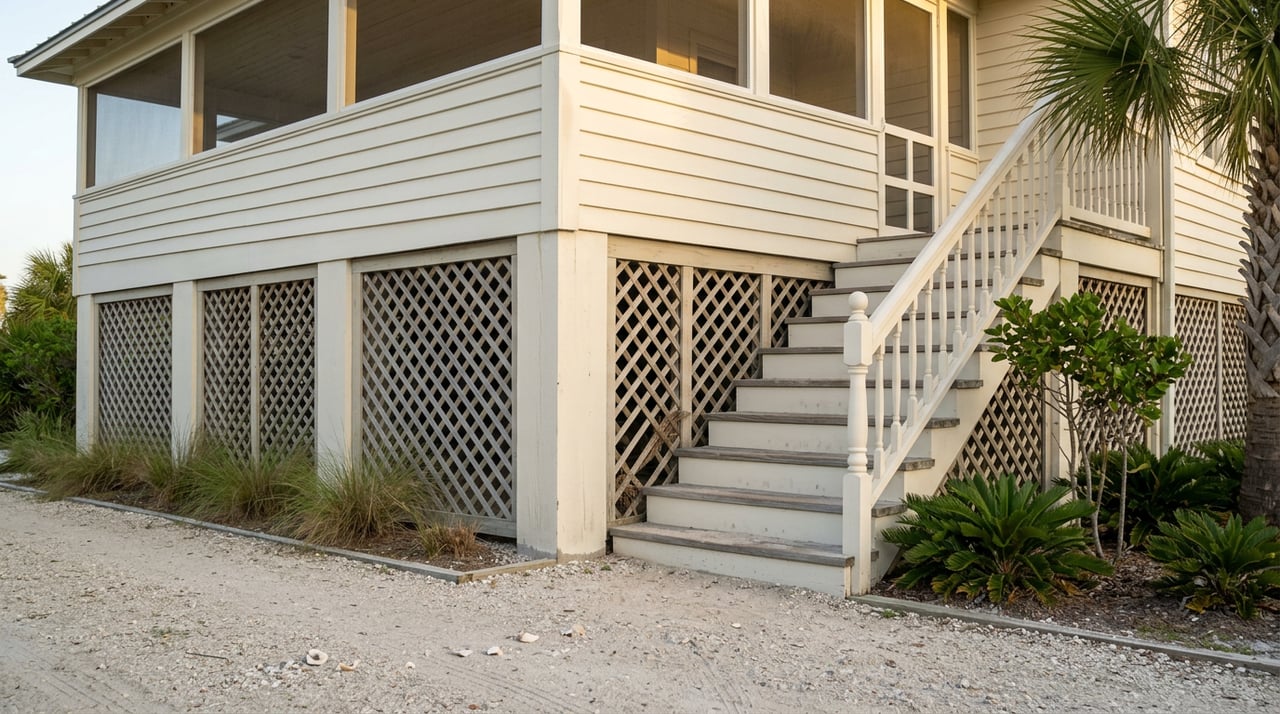
At 231 Park Ave., a Spanish-style house designed by Holmes King Kallquist & Associates was approved in spring 2025 to be raised just over five feet, with the base staying exactly as it was except for new piers, keeping the open, air-flow-through base that had always defined the house. Two properties at 255 Whiskey Row got similar approval that March. At the same meeting, 331 Tarpon Ave. was proposed for a smaller lift, 1.7 feet, with the garage staying at grade and the base elevation moving from 6.3 feet to 8 feet on the North American Vertical Datum. County staff noted that the change was not enough to visually alter the property in any meaningful way.
Each of those was approved unanimously, and the board's read has been that the island's architectural character hasn't shifted as a result. But every one of them required its own hearing, its own engineering plan, and its own sign-off. None of it happened automatically because the address sat inside a historic boundary.
Local architect Timothy A. Krebs, who has brought a number of these projects before the board, described the real challenge plainly:
"It's a tough task to make them look like they are sitting on the ground."
Raise a small cottage too high and the proportions read wrong. Krebs has also pointed out the practical costs that don't show up in a renovation estimate, like what happens to backyard access once stairs eat into a tight lot, noting it gets "tough to get the stairs in."
The July 2025 cottage case is the one worth remembering, because it shows the exemption process can fail on its own terms. A property everyone assumed would follow the same path as its neighbors turned out to be structurally too far gone to raise as planned. Instead of an elevation project, the owner was facing a rebuild, which resets the entire flood compliance calculation from scratch, this time without the option of keeping the original historic fabric that made the exemption possible in the first place.
That is the risk buyers rarely price in. The exemption reduces the odds of a forced full-code rebuild. It does not eliminate the possibility, and older wood-frame construction sometimes reveals problems only after the permit is filed and the crawlspace is opened up.
For a buyer looking at a historic cottage, the two documents worth asking for before writing an offer are the property's contributing status determination from Lee County's Land Development Code Chapter 22 historic preservation program, and its elevation certificate. Together they tell you whether a future renovation would even be eligible for exemption consideration, and how much elevation work, if any, has already been done.
For a seller preparing a historic home for market, having that contributing determination documented and available up front removes a question a buyer's contractor will eventually ask anyway. It also gives a custom-builder or renovation buyer a clearer number to work from when scoping a project, rather than discovering the 50 percent threshold mid-permit.
For anyone planning new construction inside the district, the reverse is worth remembering. New builds, even ones designed to match the district's look, are not automatically contributing structures. The fifty-year threshold and the Secretary of the Interior's reconstruction standards apply regardless of how faithfully the exterior is designed.
| Contributing historic structure | Non-contributing structure in the district | |
|---|---|---|
| Eligible for 50% rule exemption | Yes, with written state approval and county case review | No |
| Review process | Individual hearing before Boca Grande Historic Preservation Board | Standard permitting under Design Guidelines Manual |
| Typical outcome seen locally | Elevation of a few feet, footprint preserved | Full flood code compliance required if threshold crossed |
| Risk if renovation reveals structural issues | May shift from raise to rebuild, losing exemption eligibility | Not applicable, already subject to full compliance |
Does every home inside the Boca Grande Historic District qualify for the FEMA exemption? No. Only homes formally determined to be contributing structures under Lee County's historic preservation program are eligible, and that status is decided on a case by case basis rather than by location alone.
Who decides whether a renovation qualifies for the exemption? The process runs through both the Florida Division of Historic Resources, which must approve the work in writing, and the Boca Grande Historic Preservation Board, which reviews each project individually under Lee County's Land Development Code.
Can a house lose its exemption partway through a renovation? Yes. If a renovation reveals that a structure needs to be rebuilt rather than raised, the project can lose the benefit that came with keeping the original historic fabric intact, resetting the flood compliance requirements.
What should I ask for before buying a historic-district property here? Request the property's contributing status determination and its current elevation certificate. Both shape what a future renovation can and cannot do, and what it's likely to cost.
Boca Grande's historic exemption is real, and it has genuinely saved owners from the harshest version of Florida's flood rules. But it rewards documentation, not addresses. If you're evaluating a historic cottage, a waterfront rebuild, or a custom project inside the district, Olivia Jones can walk through what the county's records actually show before you're the one finding out mid-permit. Request a Private Consultation to start with the facts on your specific property.
Stay up to date on the latest real estate trends.
October 1, 2026
September 24, 2026
September 17, 2026
September 10, 2026
September 3, 2026
August 27, 2026
August 20, 2026
August 13, 2026
August 13, 2026
Whether you are looking for luxury Boca Grande homes for sale or want to list your South Florida estate, I always provide exceptional service and diligent attention to detail. If you are looking to partner with a local real estate agent who will always put your needs first, let's see how we can work together!